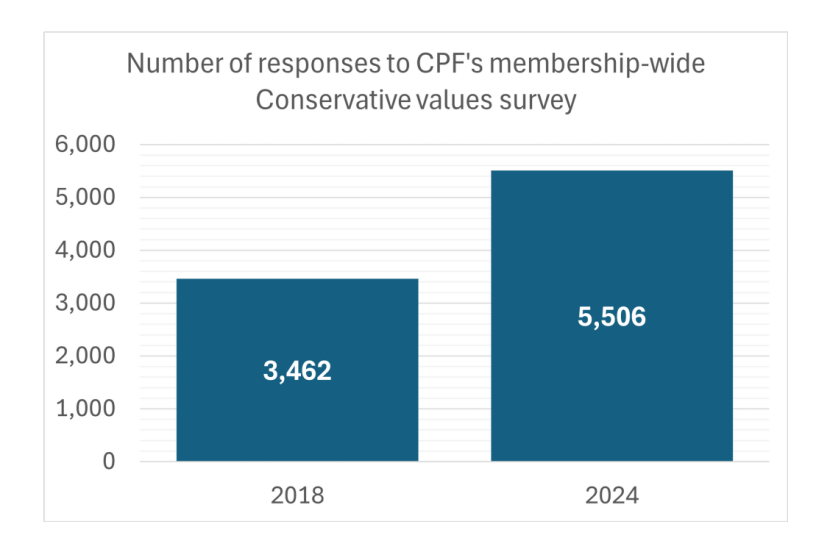
In September 2024, more than 5,500 Members from at least 584 constituencies, including 26 of the 75 in Scotland and Northern Ireland, responded to our Party-wide survey on what distinguishes us as Conservatives. This is almost 60% more responses than when we conducted a similar survey in spring 2018.
The Constitution of the Conservative & Unionist Party states that “Its purpose is to sustain and promote within the Nation the objects and values of the Conservative Party”. From Sir Robert Peel’s 1835 Tamworth Manifesto to Michael Ancram’s 2007 booklet “Still a Conservative: Conservative beliefs and principles for the Twenty-first Century”, the Party has regularly attempted to set out its values—to define what makes us Conservatives.
By conservative principles I mean … the maintenance, defence, and continuation of those laws, those institutions, that society, and those habits and manners which have contributed to mould and form the character of Englishmen, and enabled this country … to extort the admiration of the world, and in the useful emulation of peaceful industry, commercial enterprise, and social improvement, have endeared the name of England and Englishmen in every country in the world to those who seek the establishment of liberty without oppression, and the enjoyment of a national and pure form of religion, which is … the best guarantee which human institutions can afford for civil and religious liberty.
(Sir Robert Peel, 12 May 1838)
In theory—and ideally in practice—these values are the unchanging set of principles that explain who we are and that should be evident in all that we do as a Party. They are applied afresh by each new generation as we develop new policies in response to emerging challenges, ensuring that the Conservative movement stays relevant and up to date. So, although the almost two centuries-old quote above from Sir Robert Peel would need updating to replace the imperialism of his day with the unionism of today, the values and principles that he identifies (highlighted in blue) remain identifiable with modern Conservatism. All good businesses and organisations regularly review their values. So, with the Party choosing a new leader, now was felt to be a good time to re-examine our foundations.
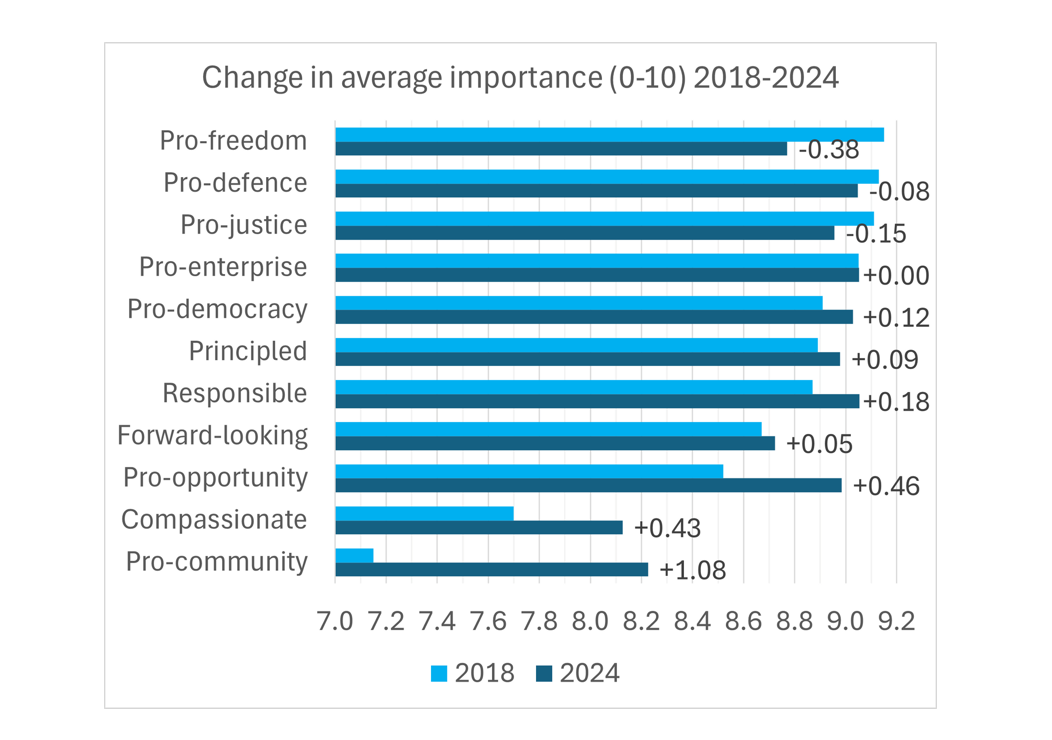
In both our 2018 and 2024 surveys, we invited members to indicate how important they felt each of several values were. This shortlist of values was compiled through a CPF consultation in the second half of 2017 in which over 1,200 members participated. Reassuringly, the level of importance that members indicated for each value has remained broadly similar. There have been some relative changes, however, that probably represent the impact of recent events (such as the UK's departure from the EU, conflict in Europe, lockdowns, disruption to global supply chains, increased volunteerism and localism, plus the scandals and short-termism that seem to blight every political age). These may represent opportunities for renewal.
What has changed?
Perhaps the most significant changes are the increased importance assigned to the values of pro-community (+1.08), pro-opportunity (+0.46) and compassion (+0.43); and the decreased importance assigned to pro-freedom (-0.38). This possibly represents a shift towards what has traditionally been called compassionate conservatism.
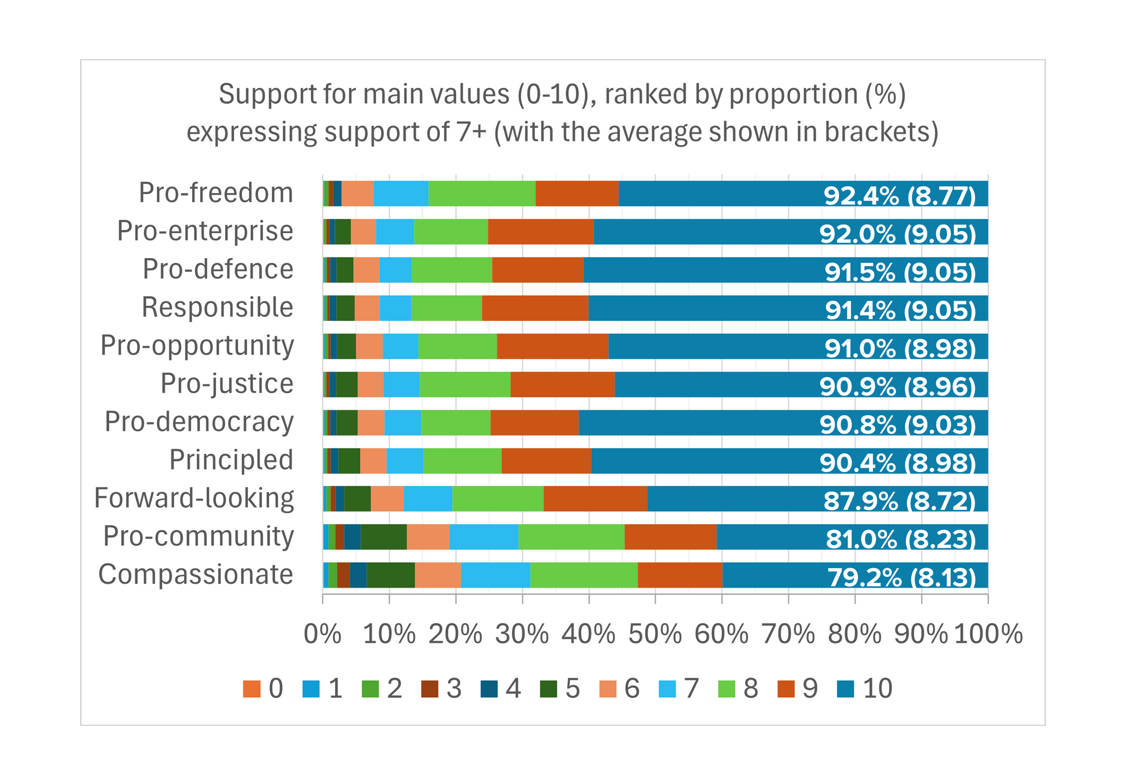
Allowing for standard errors of the means, the values that members indicate are most important for the Party fall into three groups:
Most important:
- 1.1 Responsible (personal responsibility, self-reliance; +care for others) [3.3]
- 1.2 Pro-enterprise (living within our means, support for responsible free market economy; +pro-business) [2]
- 1.3 Pro-defence (strong national defence, security, safety; +border control) [1.2]
- 1.4 Pro-democracy (pro-family, limited government, patriotism, localism, sovereignty; +accountability) [3.1]
Second most important:
- 2.1 Pro-opportunity (empowerment, equality of opportunity for all, aspiration, education, social mobility; +NOT equality of outcome) [5]
- 2.2 Principled (fairness, pragmatism, integrity, respect; +honesty) [3.2]
- 2.3 Pro-justice (rule of law, justice; +fairness/equality) [1.3]
Third most important:
- 3.1 Pro-freedom (free speech, liberty, freedom of choice; +responsibility) [1.1]
- 3.2 Forward-looking [4]
N.B. (the words in parenthesis explain what Conservatives mean by each term; the final one of these in each case, highlighted in italics, represents the aspect that members in 2024 felt most needed to be added)
[the number in square brackets indicates the relative ranking and importance identified in 2018]
Although pro-freedom has dropped from the very most important value to top of the third group, it is noteworthy that the aspect of freedom that members felt needed to be added (in order for Conservative support of freedom to be properly understood) is responsibility. Given that the value identified by members as the very most important this time was responsible, the two are clearly seen as a pair that must necessarily complement each other. In a similar way, although the belief that Conservatives are pro-community falls outside of these three core groups of values, care for others is the aspect that members most said needs to be added to explain what Conservatives mean by responsible. Only by taking the set of values together can the essence of Conservativism be rightly captured or understood.
When we asked if there was one value that members thought should be added to the list, the most frequently mentioned, by far, was honesty, followed by integrity. Both of these were captured in the original list by the word principled. More than 1-in-45 suggested patriotism. This aligns with the aspect that members indicated most needed to be added to our support of community—namely, integration.
As part of our membership-wide survey on Conservative values, we invited members to reflect on the extent to which they thought each of various stakeholders are involved in the process of making and presenting the Party’s values and policies.
Intriguingly, most groups completing this exercise in the past, using the same 0-10 scale, have suggested that many of the stakeholders in the list have very low influence on either making and/or presenting policy, assigning scores of 0-2 for those they consider to be least influential. This time, the average scores were almost all in the 5-10 range. In order to reveal the perceived relative influences more clearly, I have rescaled the results to the wider 0-10 scale, preserving the relative positions.
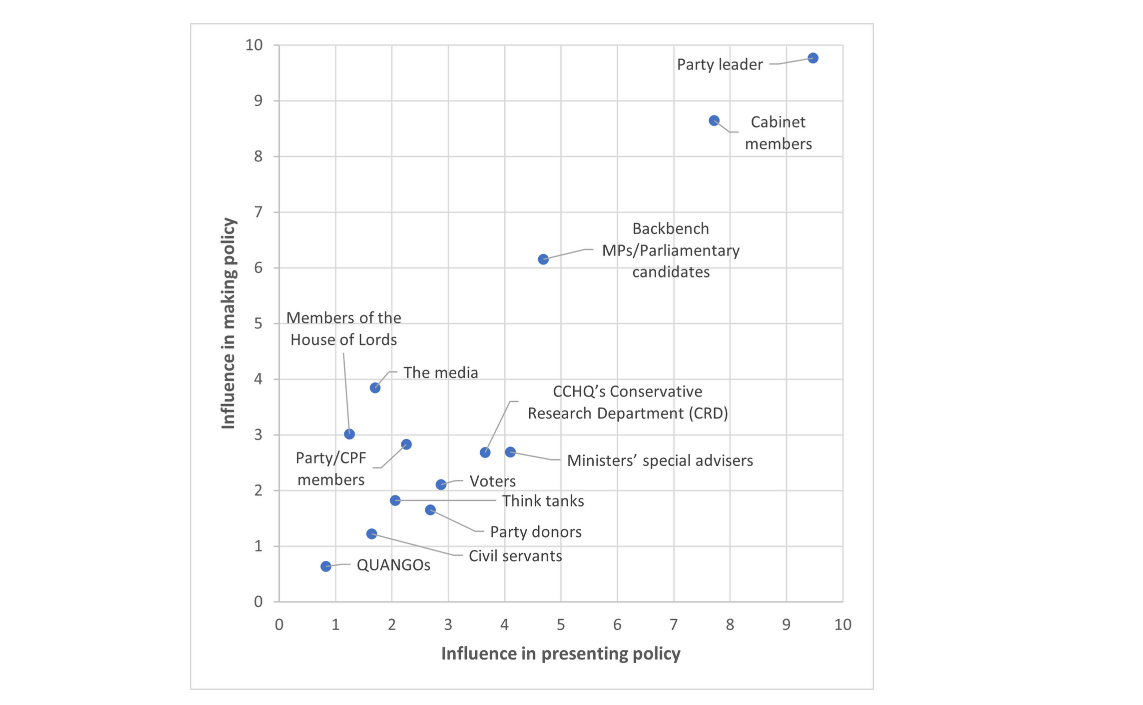
Unsurprisingly, the figure perceived to be most influential in both making and presenting policy is the Prime Minister, followed by members of the Cabinet. Some way behind these, elected Parliamentarians come next, along with parliamentary candidates, for whom we should perhaps have invited members to choose a separate score.
After these elected groups, the stakeholder perceived to be the most influential in making policy is the media, which clearly reflects the extent to which the media is seen to shape public opinion and, often, to ensure that a particular issue or campaign is taken up (or ignored) by politicians.
Among the non-elected stakeholders, the groups perceived to be most influential in presenting policy are ministers' special advisors (the SpAds) and members of the Party's Research Department (CRD). Presumably, in both cases, this is not because they are seen to present policy themselves (they are generally unseen and seek to stay out of the public eye) but because they are responsible for briefing the elected Parliamentarians on what they should say.
The relatively high levels of influence attributed to voters, in particular, suggests that the whole policy-making process is not especially well understood. Yet, in fairness, attempts to describe it do not come easily. Consider, for instance, the following quotation:
Policy decisions are seldom taken by political office-holders in a vacuum: analysis and proposals are generally prepared in great detail by official advisers (civil servants), sometimes working with ministers’ appointed political advisers (in the UK properly called special advisers), and the advice and eventual decisions are both shaped by the influence and advocacy of a wide range of interest groups in business and civil society, opinion formers in the media, allies and opponents in parliament and the political parties at large, and academic experts. There are thus many potential points of access to influence and inform decisions, but many are quite indirect in effect and their efficacy difficult to assess. Subordinate decisions about the detailed (sic) and implementation of policy decisions and the application of policy to specific cases will often be taken by officials without reference to ministers unless the issue is potentially politically contentious or has wider policy implications.”
(Understanding the policy process, University of Oxford)
That being said, we asked members three questions linking values with the Party's role in policy-making. The following quotations are representative of the most common responses:
In what ways do you think the Party could improve how it develops and applies the Party’s values and policy?
- “Listen to members.”
- “Genuine conversation to find new ideas and solutions.”
- “Fully check any new proposals against the fundamental values of the Party.”
- “We need a compelling, overarching vision statement.”
In what ways do you think the CPF could improve how we identify, refine and promote Conservative policy ideas?
- “Have weekly surveys on the burning topics.”
- “Regular policy meetings between CPF members and cabinet ministers.”
- “More open questions and topics, including sensitive and ‘politically incorrect’ ones.”
How might all these values be better embedded in all aspects of the Party and its activities?
- “Place the values in the Party’s constitution.”
- “Repeatedly communicate the list to all the Party until they are embedded.”
- “Base MP candidate selection on closeness to these values.”
- “Redesign the Party’s website around our values and principles.”
The final part of our membership-wide survey on Conservative values sought to understand Members' views on being a member.
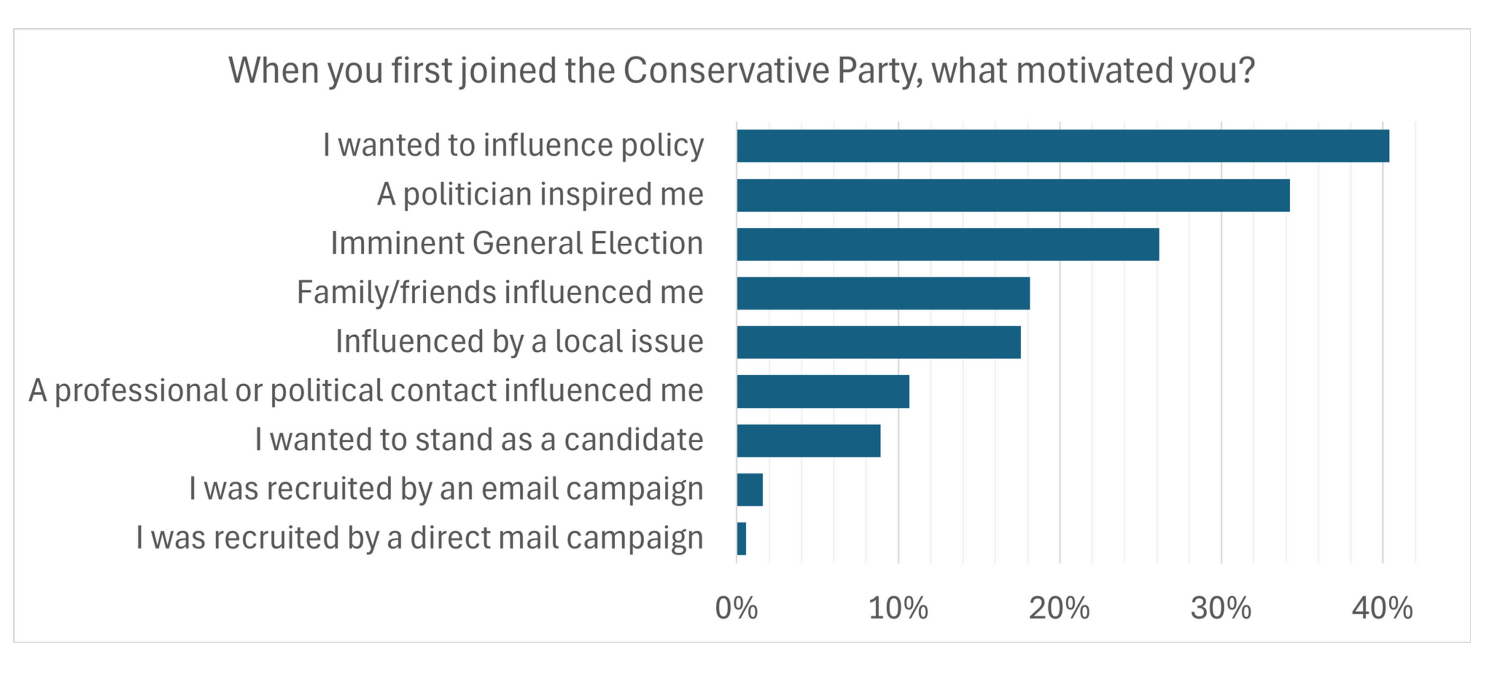
The biggest factor in what first motivated people to join the Party was a desire to influence policy (40.4%), followed by being inspired by a politician (34.2%) and the prospect of an imminent general election (26.1%). Other significant factors included the influence of family or friends (18.1%) and being influenced by a local issue (17.6%):
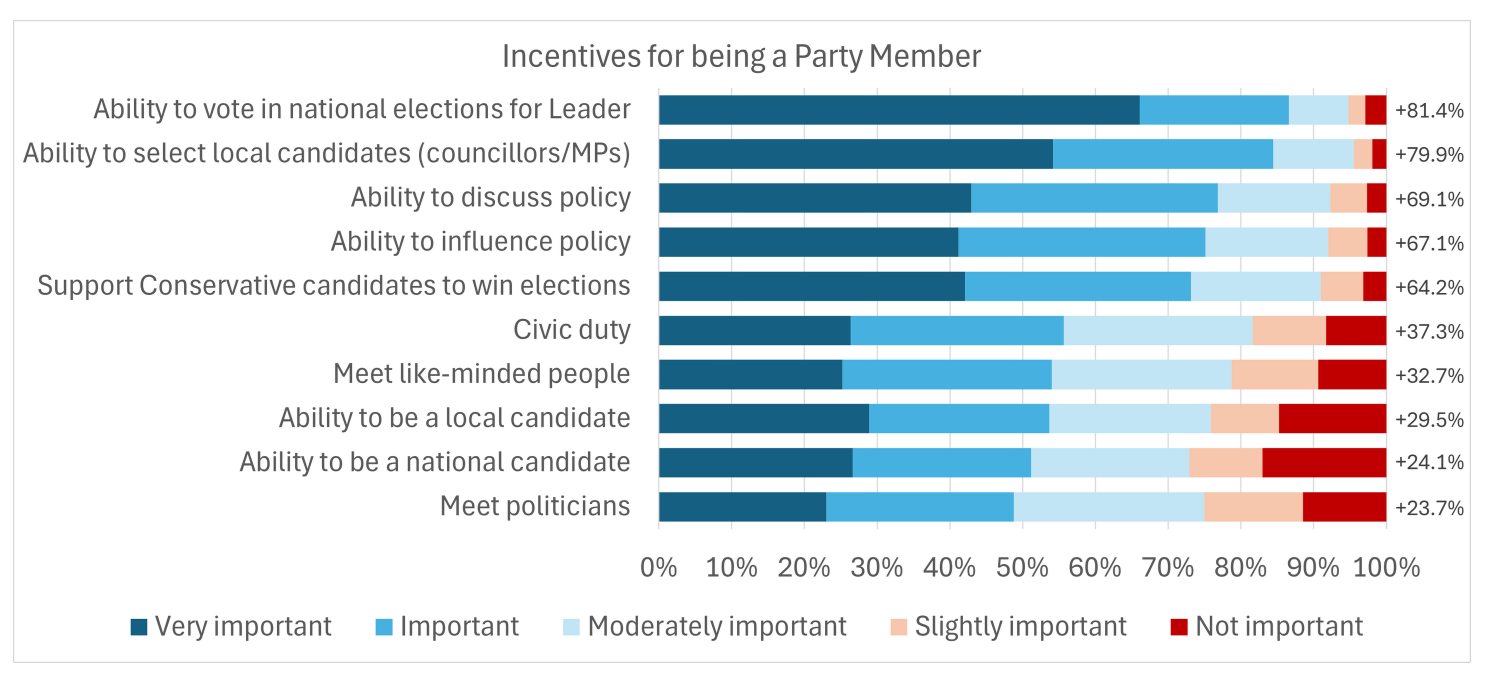
Members indicated that the most important incentives for being a member are the ability to vote in national elections for the Party Leader and to select local candidates (councillors and MPs). The second most important incentives were the ability to discuss and influence policy, plus supporting Conservative candidates to win elections. Civic duty and a desire to meet like-minded people topped the remaining factors. The least important factors were the ability meet politicians and to become a local or national candidate.
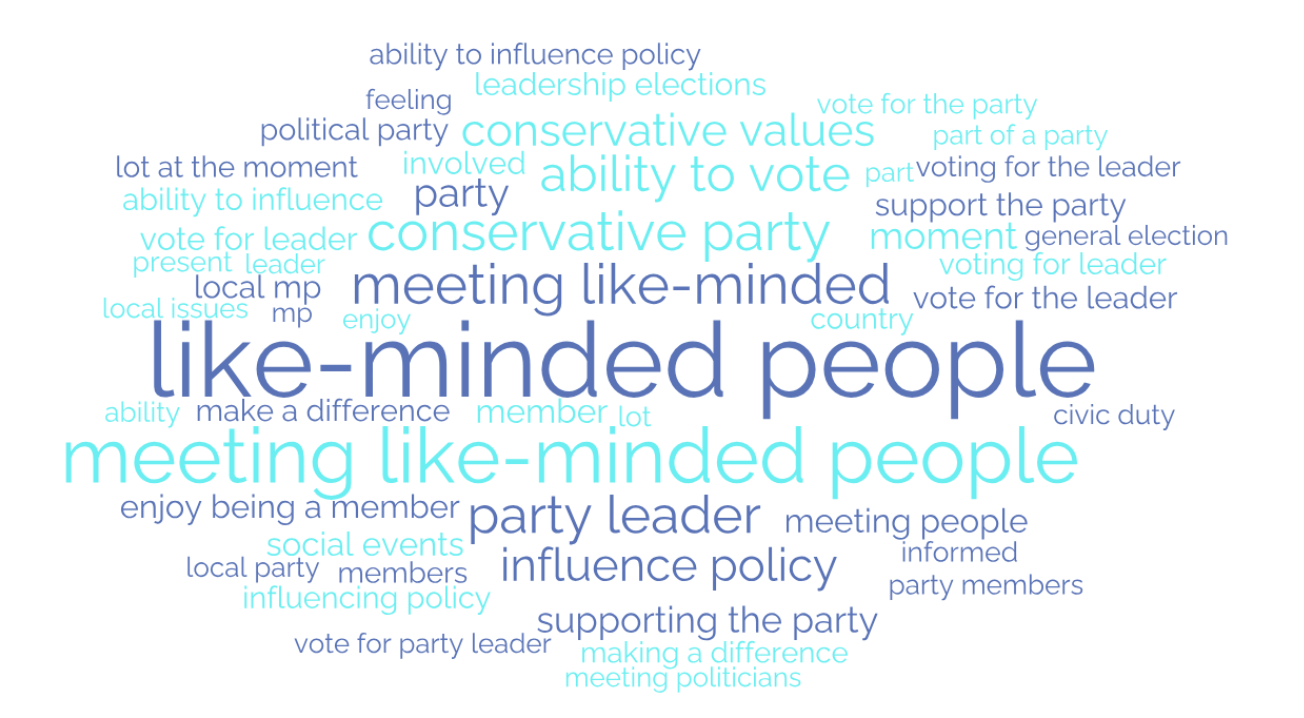
Lastly, we asked people what they most enjoy about being a member. Overwhelming, the most common responses were “Socialising with like-minded people” and “Meeting MPs at social events.” Other common responses included “Having a say and being involved in local and national issues” and “The ability to choose the local candidate and party leader and to discuss and influence policy.” The word cloud below captures the most frequent words used in responses.